Sunday, October 24, 2010

Prague, the Golden City


Prague is the capital city of the Czech Republic.  Also known as the "golden city" and the "mother of cities," Prague has been a major city in the region for over a millennium.  It was once the capital of the Holy Roman Empire and of Bohemia.

Of all the great cities of the world that I've seen, there are few that compare to Prague in terms of beauty.  Prague's got it all: magnificent buildings large and small, cobblestone streets full of shops and restaurants, a great river adorned with pretty bridges, and a great castle overlooking the city. 


Let's start at the heart of the city: Old Town Square (Staromestske Namesti). It's a large, beautiful town square, first established in the 10th century. It ranks up there with the other great town squares of Europe. The photo above is a cool panaroma of the square, stitched from multiple shots. Click on it to enlarge. Several of Prague's most significant landmarks surround the square.


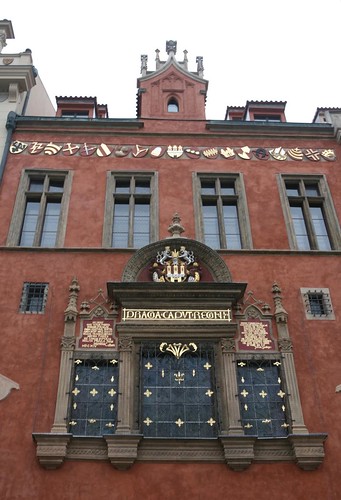
The first great building by the square is the Old Town Hall (Staromestske Radnice).  The hall features a Gothic and Renaissance tower, plus a fancy astronomical clock.  This landmark is one of Prague's top tourist attractions. You can buy tickets to go up the tower for a great view of the city (we didn't). The clock is a technological marvel, considering its creation during Medieval times. It performs a glockenspiel-like show every hour.


Another great building at the square is the Church of Our Lady Before Tyn.  This Gothic-styled church was built in the 14th century. 


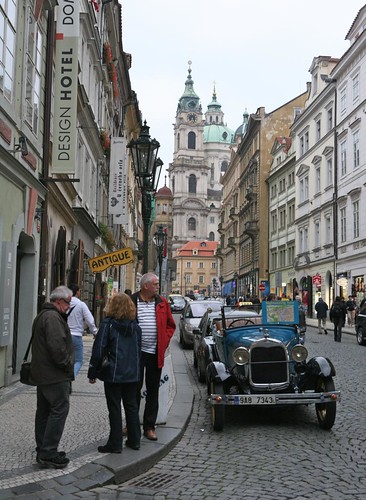
Prague is a great city for visitors to walk about.  It's a large city though; you'll get a nice workout walking everywhere.  In fact, I ripped a large hole through the toes of a sock after walking all day.  The streets are pleasant, safe, and tourist friendly.  You see shops everywhere, and you can eat food from all over the world.


Another nickname for Prague is "city of a hundred spires."  You can indeed stumble upon many a spire or tower as you're exploring the city.


The Vltava (Moldau) River runs through the center of Prague.  To span the river, a bunch of bridges have been built over the centuries.  The most famous of the bridges is the Charles Bridge (Karluv Most).  First built in the 14th century, this bridge connects the Old Town with the Prague Castle area.
It is a very picturesque Gothic bridge, adorned with Baroque-styled statues standing tall.


The Charles Bridge is a very popular tourist destination.  The bridge is flooded by tourists, lovers, sellers, beggars, artists, and musicians every day.


Sitting atop a hill on the western side of the Charles Bridge, Prague Castle (Prazsky Hrad) overlooks the city.  The castle has been around since at least the 9th century.  This castle was the defensive structure around which the city of Prague grew.  Prague Castle is the largest castle complex in the world. Emperors, kings, and presidents have resided within.


You can get a great view of the city from Prague Castle.  Below is a panorama of the cityscape.  Click to enlarge it.  Imagine being a king and seeing this view every day...


Prague Castle is definitely a worthy visit for tourists.  You can purchase a ticket, which allows you to see the churches, palaces, and museums within the castle complex.


The most obvious attraction within the castle complex is St. Vitus Cathedral.  It is by far the tallest structure in the city; you can see it from anywhere.  This Roman Catholic cathedral is the most prominent church in the Czech Republic.  The archbishop is based there.  Kings and emperors are buried there. 


St. Vitus Cathedral is a masterpiece of Gothic architecture.  Flying buttresses and spires are found everywhere in this building.  Inside, you'll find beautiful stained glass windows and crypts.  The cathedral's construction first began in the 14th century, but construction stopped after about 50 years.  The cathedral was left unfinished for hundreds of years.  Finally, work in the 19th and 20th centuries completed the cathedral - 600 years later.


Another landmark within the castle complex is St. George's Basilica.  It is older than St. Vitus Cathedral.  Built in the 10th century, St. George features a Romanesque architecture.  Ludmilla of Bohemia was canonized and buried there - hence it is a basilica.


Ok, back to the city.  Prague has a really nice and refined area called the Jewish Quarter.  In addition to lots of nice shops and restaurants, the Jewish Quarter is home to a number of Jewish landmarks.  You can buy a ticket that lets you see six of them.  After having gone through Prague Castle earlier that day, however, we were sick of museums, so we did not check out the Jewish buildings.  Here's a photo of the exterior of the Spanish Synagogue though.  Its interior is supposed to be amazing....


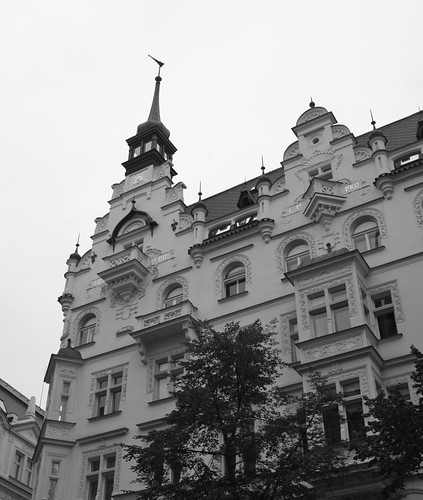
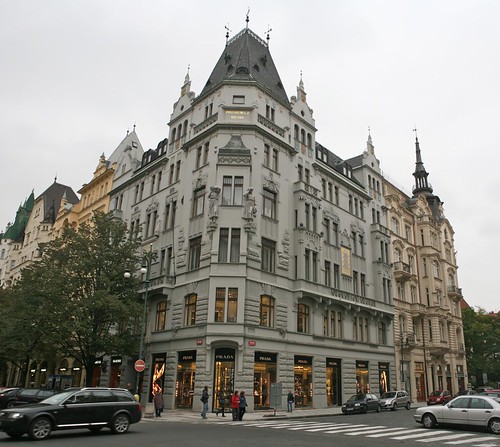
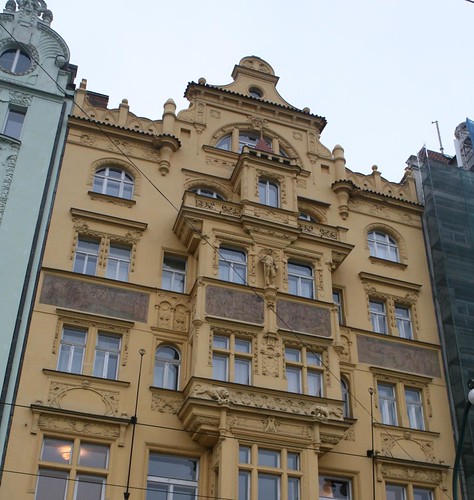
Speaking of buildings.... Several friends who went to Prague in the 90's mentioned that the city appeared rather run down at the time.  Makes sense, since it was right after the Cold War.  I don't have that experience to compare with.  However, I did notice how clean and elegant many of the buildings in the central city appeared.  Looks like they put a lot of money into restoring the city's beauty.  It seems that tourism has flourished in Prague over the last twenty years.


More on buildings...  As you have seen, Prague boasts some great Old World scenery.  But there's a little bit of new stuff here too.  One landmark in particular stands out - Frank Gehry's Dancing House (Tancici dum), also known as the Fred & Ginger House.  Frank Gehry is a famed architect who has designed crazy "Deconstructionist" buildings all over the world.  He designed the Priztker Pavilion and BP Bridge in Millenium Park in Chicago.  The Dancing House sits at the corner of a street in Prague, facing the river.


Finally, let's talk about a most intellectual of topics: beer.  Since our trip was about Oktoberfest, we had to continue the beer theme in Prague.  Actually, it was not difficult to find beer.  The Czech Republic apparently has the world's highest consumption of beer per capita, beating out worthy nations like Ireland and Germany. 


You can get some great brews here, and for very little money.  The ubiquitous pilsner style of beer comes from the city of Pilsen in the Czech Republic.  Perhaps the most well known Czech beer is Pilsner Urquell.  But did you also know that the American beer Budweiser was first brewed in the Czech Republic and is known as Budvar? Budvar tastes a ton better too...


Well, that wraps up a highly enjoyable stay in Prague. Unfortunately, I didn't have enough time to capture its beauty as much as I would have liked; not to mention, the weather didn't cooperate.  But I got a great taste of its beauty and intend to come back one day to see more.

Next stop on our trip: Berlin!

Related links:

Friday, October 22, 2010

There's more to Munich than Oktoberfest

We needed a distraction from the huge crowds and many liters of beer of Oktoberfest.  So we did some wandering around in Munich.  This gave us an opportunity to appreciate crowds and beer in other areas of the city :)


Marienplatz (St. Mary's Square) is the town square at the heart of Munich.  It's been around since the Middle Ages - a place in which wondrous public events like knightly tournaments and executions were held.  Although we didn't notice any tournaments or executions, there was still a lot of people in the platz.


The main attraction in Marienplatz is the Neues Rathaus (New Town Hall).  It's a beautiful Gothic building.  A large crowd appears in the middle of the day to check of the Glockenspiel, silly ceramic statues that parade around in a circle in the tower of the Rathaus for a few minutes.


Leading in and out of Marienplatz is a pedestrian-only street, lined with shops and restaurants.  It was really nice being able to have a leisurely walk through the city center.


As we walked around, we admired many beautiful public buildings.  I have no idea what the buildings were, but they looked cool.


There's something wrong with you if you visit Munich without checking out a brauhaus or two. Needless to say, we had to stop in :) Here are photos of brauhauses by Augustiner and Paulaner breweries.  Unfortunately, we didn't have time to visit the most famous of them all, the Hofbrauhaus.  But hey, I've been to the Hofbrauhaus in Vegas many times - that should count, right? :)


Guess what we did inside the brauhauses? :)


By now, you must be thinking that all we did in Munich was go inside some brew place and drink beer.  This was not the case.  In fact, we spent a relaxing afternoon outdoors in the English Gardens.  It's a large park in Munich, complete with running trails and ponds.  Then we drank beer here :)


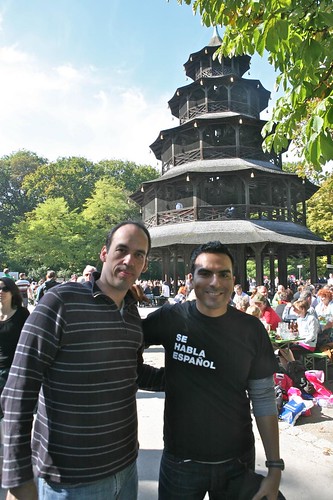
I'm not really sure why it's called the English Gardens.  There seemed to be a bit of Asian influence at this park.  Case in point - this large pagoda in the middle of the park.  Lots of people liked to have a picnic on the benches by the pagoda, listening to the oompa loompa band playing in the balcony.


We enjoyed a lovely meal here as well.  I was introduced to an excellent dish called schweinshaxe.  Otherwise known as roasted ham hock, or pork knuckle.  It's like a turkey leg, but it's pork!  Had to wash it down with a mas of beer too :)


Alex, who owns his own bar in Mexico, found some work even in Munich :)


And that wraps up our stay in Munich.  Next stop - Prague!

Related links:

Monday, October 18, 2010

Eins, zwei, drei - Oktoberfest in Munich!

I was pretty excited to travel to Munich for Oktoberfest. How many crazy big parties are there in the world? Carnivale in Rio, the running of the bulls in Pamplona - what else? Oktoberfest is right up there - one of those things you need to do before you die.

I've been to Oktoberfest in other cities. Chicago has a couple festivals. I've even been to Oktoberfest in Stuttgart, Germany. These experiences should have prepared me for Munich, right? Not at all. Munich's Oktoberfest dwarfs everything else. Imagine seeing a local cover band playing a U2 song and then seeing U2 for real in a large stadium.  It's a huge difference.  Oktoberfest in Munich was impressive! Not to mention - 2010 is the 200th anniversary of the festival.


Oktoberfest is located in a very large field called Wiesn, fairly close to the central train station in Munich. We went on Saturday and Sunday. On Saturday, we arrived at 7am. Yes - in the morning! The above photo is of a lovely sunrise over the Augustiner beer tent in Wiesn. We were told to go early, hence the 7am start. But even at this time, there was a packed crowd waiting to get in to the popular Hacker-Pschorr tent. I would show you a photo of the crowd, but it was packed in so tightly that I couldn't even lift my arms to reach my camera for a photo! After waiting almost two hours in line, I still couldn't get into the tent! We had to go to another tent.


As a veteran of Chicago festivals, I'm used to big crowds.  The Taste of Chicago boasts something like a million visitors.  Can you believe Oktoberfest is bigger?  Five million visitors come to Oktoberfest every year.  Wow.  In fact, it's the world's largest fair.  I can believe it.  It's a huge carnival atmosphere.  There are rides, ferris wheels, and games for everyone to enjoy.  You are drowned in a sea of people from dawn to dusk.


Even though you're in the largest fair in the world, the fair is not even the main attraction to Oktoberfest. Oktoberfest is about the beer, and you celebrate beer inside beer tents and beer gardens.  Wiesn features a bunch of large tents and beer gardens, hosted by the major Bavarian breweries such as Hofbrau, Hacker-Pschorr, Augustiner, and Paulaner.


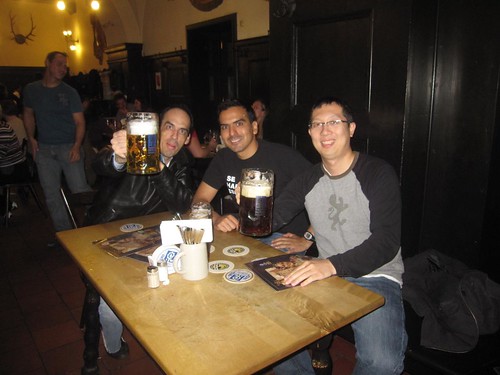
The experience inside the beer tents is crazy. We spent most of our time inside some tent or other. Each tent is huge - the size of a football field.  Actually, the "tent" is not really a tent - it's a solid, wood-and-steel structure, even with platforms for a 2nd story on the ends.  It's packed with people. You have to be aggressive to find a seat at a table - and you have to be at a table in order to be served beer. Here are some photos from the Pschorr and the Hacker-Pschorr tents.


Alex, Mo, and I were joined by Mo's brother, Salim, in Munich. Not only was he a cool guy, he speaks German! It was nice to have a Mexican-with-Middle-Eastern-name-who-lives-in-Germany friend and tour guide hehehe. Can you believe the resemblance between Salim and Mo? :)


At Oktoberfest, everyone gets the same beer.  It comes in one size - one liter.  This size beer stein is called a mas.  "Ein mas, bitte!"  Yummy.  German beer is so tasty.  And German beer quality is awesome - you never get a hangover!  Hmm, how many mas did I have???


A key to a successful day of drinking is to eat well.  And eat well we did!  You may be familiar with the large German pretzel and wiesswurst.  Very tasty!  What was new to me, however, is an even more traditional item.  It's a roast chicken called Hendl.  So good!!  Yum yum yum....


Oompa-loompa bands kept us entertained at the beer tents. We in the USA are used to small bands of 2-4 members. In Bavaria, they have full bands of over 10 members! It was fun singing along on top of the table, while occasionally chanting "ein prosit" or "eins, zwei, drei, g'suffa."


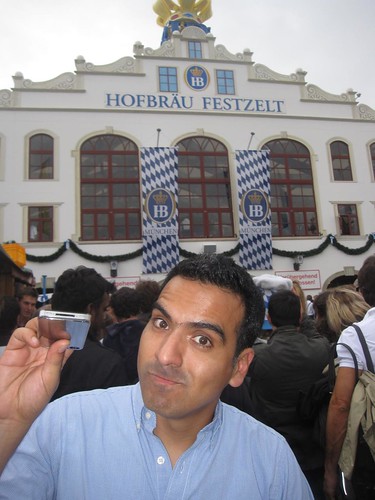
Just outside the beer tents were the biergartens. It was nice to hang outside, especially when it was warm and sunny. The biergartens were usually less crowded than the tents.  Here are some photos of us at the Hofbrau biergarten, with some of Alex's friends (German peeps he knows from Mexico).


When you're drinking beer all day in a tent, you're bound to make some new friends.  It was a very friendly place!  There were obviously many Germans around.  But we met other Europeans - Dutch, Belgian, etc.  Also met some Americans and even more Mexicans!


The final thought I'll leave you with is about all the cool clothing people wore to Oktoberfest.  You've probably heard of lederhosen before - the leather breeches than German men wear, typically with some kind of checkered shirt.  German women wear these dresses called dirndl - very pretty!  These costumes are quite expensive - I hear they run you $200 or more!  I had to train my camera to the  ladies in dirndl to appreciate some... cultural awareness....


Whew! Oktoberfest was quite the experience! I will definitely remember the time here. Maybe I'll brag about it to my grandchildren one day...

Thursday, October 14, 2010

A quick stroll through Zurich, Switzerland

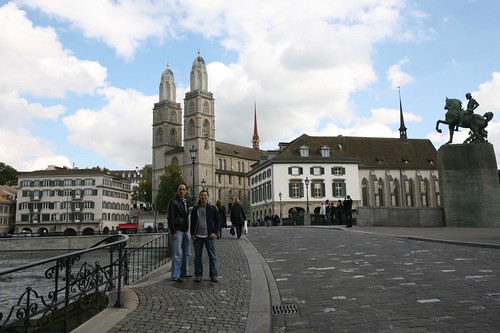
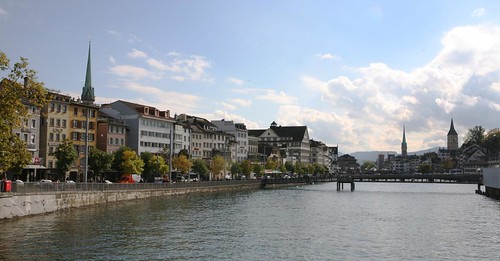
Our Oktoberfest Euro trek started in Zurich Switzerland. Alex, Mo, and I originally had a flight connecting through JFK New York and landing in Zurich at 7am. However, bad weather in NY caused our flight to be canceled. We were re-routed through London and finally arrived in Zurich around noon. We had a train scheduled to depart for Munich at 3pm, so it left little time to spend in Zurich. Nonetheless, we were still able to do a quick stroll through Zurich.


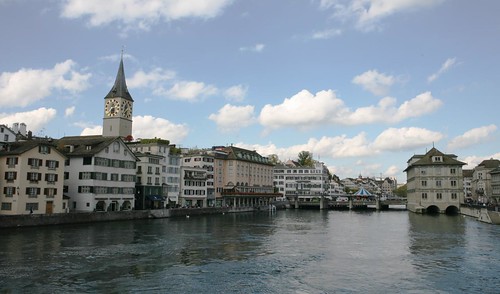
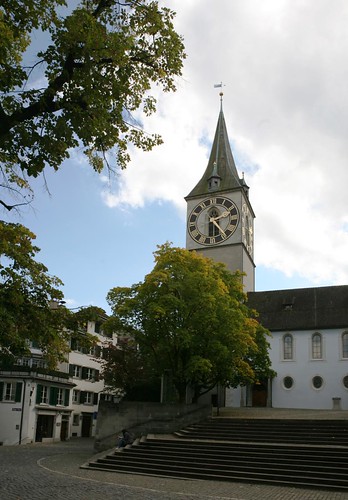
Zurich is a pretty city. Although it's the largest city in Switzerland, it is so quiet and orderly that it feels like a small town. The city is immaculately clean and well-groomed (kinda like in Paris).  The architecture is very German.  Kinda makes sense - everyone here speaks a Swiss dialect of German.


Zurich is situated just north of Lake Zurich. A small river cuts through the town and leads to the lake. The prettiest sights in town are next to the water.


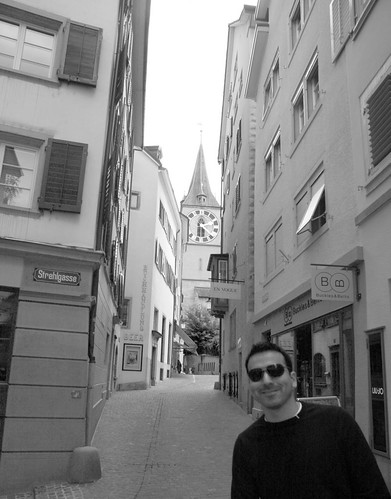
Small cobblestone-lined streets wind through the city, inviting you to wander about aimlessly.  Small stores and restaurants are everywhere.  It's fun to walk around here - you never know what's around the corner.


One thing you'll notice immediately in Zurich is all the trams and buses on the streets.  Zurich has the highest density of public transportation in the world.  It consistently ranks near the top cities of the world in quality of life too.


After our short visit in Zurich, it was quickly time to get to the train station.  Next stop: Munich and Oktoberfest!!