Showing posts with label France. Show all posts

Monday, May 27, 2013

France 2013: Normandy, WWII, and Memorial Day


Happy Memorial Day in the USA!  Normally I think of the summer and barbecuing on Memorial Day.  But today is cold and rainy.  And my France experience is still on my mind.  It's only fitting that I write about Normandy and its WWII D-Day sites today.  Visiting these places certainly made me remember and honor those of us who have served for our countries.


The Normandy coast sits on the English Channel.  England is directly north.  Although it's not the closest place in France from England (Calais is), the Allies chose Normandy as its target for the D-Day invasion.  Five areas of coastline (known as Utah, Omaha, Gold, Juno, and Sword Beaches), were the landing points for the Allied troops.  For the rest of the story, go watch Saving Private Ryan :)

Normandy Coast Towns


The drive along the Normandy coast was relaxing.  There are a bunch of small seaside fishing towns.  Each one had some kind of memorial or museum dedicated to WWII.  I don't remember all the towns we went through, but it was all nice.  Too bad it was cold and rainy that day.  I would have enjoyed sitting on a pier and eating some seafood...


Perhaps the best scenic view of the Normandy coast was at Arromanches, pictured above.  Cliffs overlook the town on both sides, so you can get a great view.  There's a memorial/museum area here too.  Arromanches was the site of the WWII Mulberry Harbor, a portable temporary harbor built by the Allies to unload troops and supplies in order to win Europe back from the Nazis.  In the photo, the four objects in the water are remnants of the Mulberry Harbor.  There are some great WWII photos of the harbor in the museum onsite and on the internet (follow the link above).

Omaha Beach


When it comes to D-Day, Americans probably remember Omaha Beach the most.  Unlike the other beaches which were fairly easy to overtake, Omaha Beach was nasty.  It overlooked bluffs rising up to 150 ft.  German fortifications covered the beach.   Needless to say, thousands of people died on those beaches that day.  Once again, refer to Saving Private Ryan for more detail - its Omaha Beach invasion scene was amazing.


Today, there isn't much to see at Omaha Beach.  The area is a big memorial park now.  Almost all the fortifications are gone.  If you walk out a bit, you can see some bomb craters and perhaps a few remnants of the battle.


The main thing to see at Omaha Beach is the American Cemetery.  About 10,000 soldiers are buried here.  Makes you think about life a bit when you visit.  Thanks again to all those who have served.

It's crazy to think that the Nazis had a good chance of defeating the Brits and conquering all of Europe.  I was born a couple generations later, so the feeling wasn't the same as those who lived through it.  But seeing a few things sends a shiver down your spine.  On this trip, we had a long layover in Berlin and visited some of the landmarks there too.  They have a nice outdoor exhibit on the rise of the Nazi party in Germany.  And below is the Holocaust Memorial in Berlin - a tribute to the millions of Jews who were systematically persecuted and murdered by the Nazis.


Caen


There are a few bigger cities in the Normandy area.  One of them is Caen.  We stayed at a hotel there.  Caen was a major site in WWII during the Battle for Normandy (which started on D-Day). A significant portion of Caen was destroyed and was later rebuilt.  However, the medieval core of the city remains intact.  Below is the Chateau de Caen, or Caen Castle.  It was built by William the Conqueror, who led the Norman invasion to conquer England in 1066.  Across the street is the Church of St. Pierre, located across the street from the castle.  There are a few other churches you should see if you go there - Abbaye aux Hommes and Abbaye aux Dames - but we got lost and couldn't find a parking spot....


Related Links:

Saturday, May 25, 2013

France 2013: Le Mont St. Michel


Le Mont St. Michel is a very unique combination of characteristics: island, mountain, castle, monastery, medieval town, geological phenomenon, architectural marvel, and a place of legend.  Built sometime around 700-800 CE, the town and its fortifications have served a strategic role in the region over the centuries.  Le Mont has a special place in the hearts of the French.  Many songs, stories, and movies have referred to it.  I've personally wanted to visit it since I was young.  Finally seeing it in person was amazing.

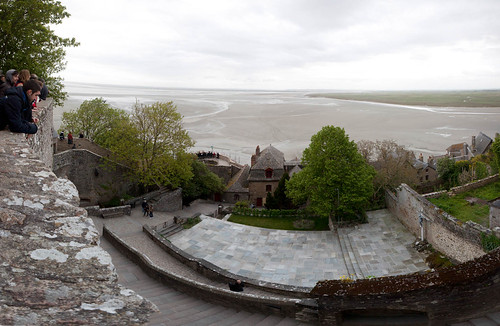
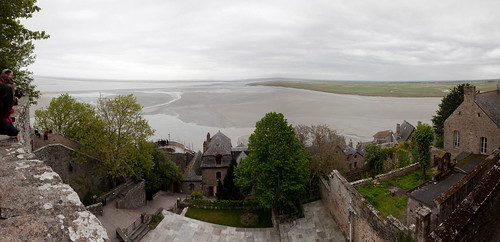
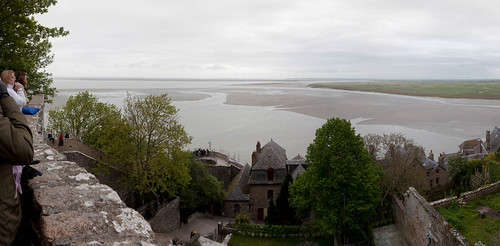
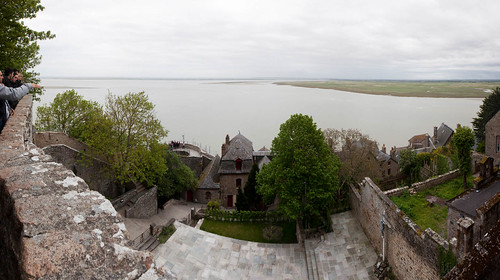
Le Mont is located in a shallow bay in Normandy (northwestern France).   It is classified as a "tidal island," which means it is surrounded by water when the tides are high.  During low tide, you can walk over from the mainland.  Just don't get caught when the water rises; the water level goes up quickly, and the quicksand can be deadly!


Inside Le Mont St. Michel


There's a single road that connects the island to the mainland.  The road gets lots of traffic - 3.5 million tourists and Christian pilgrims visit the town every year.  They are currently renovating the area, changing the water flow with a new dam and building a new raised road leading to the town. There are a few small but expensive hotels on the island itself. We stayed on the mainland, however. It was much cheaper, and you can just walk or take a bus over to the island.


When you first enter the island, you walk through the tiny medieval town. Less than 30 people officially live on the island today. Le Mont has never had more than 1500 inhabitants over its entire history. The town probably had some interesting shops back in the day - carpenters, blacksmiths, etc. Today, it is only for tourists: souvenirs, food, and lodging. You need no more than a couple hours in town and less than a day at the site in general.

The fortifications of Le Mont are quite impressive. The island is completely surrounded by city walls. The central core of the mountain is situated at the top of the mountain and covered with more walls. Imagine launching projectiles from a catapult from the top!


The top of the mountain is reserved - for God!  There's a Gothic-styled Benedictine Abbey up there.  It is dedicated to Michael the Archangel. To get there, you need to walk up a bunch of stairs, but the view is amazing.  You can also pay a fee to tour the Abbey, but we chose not to do it.

The Tides


Perhaps the most unique aspect of Le Mont is the tidal flow.  I'm not aware of any other landmark in the world that is sometimes part of the mainland and sometimes an island.  It just takes about 60 minutes for high tide to cause the town to be completely surrounded by water.  We climbed the steps to the abbey and watched the tidal phenomenon happen.


#1: 7:22pm
#2: 7:46pm

#3: 7:58pm
#4: 8:14pm


Related Links:

Friday, May 24, 2013

France 2013: Trip Overview


Bonjour, messieurs et madames!  I just got back from a très magnifique, two-week trip to France.  Unlike my typical trips with friends, this one was a family vacation.  My parents just had their 40th anniversary, and I wanted to take them on a trek in Europe while their health was still in good shape. 
Our trip was spent entirely in northwestern France.  It was the second time in France for all of us. Aside from Paris, all the places we visited were new to us.

Trip itinerary & blog article index:


1) Flew in to Paris (A). With a long layover in Berlin
2) Normandy coast (B): The historic sites of the WWII D-Day invasion
3) Le Mont. St. Michel (C): The medieval city built on an island mountain (photo at top of this article)
4) Loire Valley (D): Region filled with beautiful chateaux (castles/mansions) built by French royalty
5) Chartres (E): Home of the beautiful gothic Cathédrale de Chartres.
6) Paris (F): 4+ days wandering the most beautiful city on the planet

As I write more, I will link to blog articles on the above locations. 

Here are maps of our trip.  The one on the left is a macro view, showing where we were in relation to France overall.  The one on the right shows more detail on the specific locations.


Getting Around

We rented a car to travel to all these locations. It was a great experience. The Normandy coast has a lot of small sites that you can visit, so having our own car allowed us to visit them at our own pace. The car was great for the Loire Valley too, since there are 10-20 chateaux you could visit. We planned around the big chateaux(Chambord, Chenonceau, Villandry); for the rest, we played it by ear. The French countryside was beautiful too. We really enjoyed driving through all the small towns and peaceful country roads.

When you rent a car in Europe, most cars you get are manual transmission. I was the sole driver, and I can only drive an automatic. So I reserved an automatic for a lot more money... but hey, it was a "premium class" rental - so they gave us a BMW 5 Series! What an awesome car for a road trip! The photo above is me with the BMW, in front of Chambord, the most grand of the chateaux in the Loire Valley. It also came with an excellent built-in GPS system, which saved us from getting lost many times.


Driving in Europe has its good points and its bad points. On the bright side, highway driving is great. Everyone is taught to drive very well, it seems. You rarely see slow drivers in the passing lane. People move aside to let faster drivers pass. And you don't see clueless cell-phone users cluttering up the roads. On the other hand, driving in cities and towns can be a pain! The streets are very small and crowded, and directions aren't marked clearly. Parking spots are tiny too. Most cars are very small compact and sub-compact cars; our BMW was quite a behemoth on the roads! Luckily, I managed not to hit anyone or anything...


The one place I did not drive in was Paris. Driving in Paris, just like any of the world's largest cities, is a complete mess! No way! We took public transporation instead. The metro and bus systems in Paris were excellent. Trains ran very frequently and were comfortable (and not smelly and rickety like Chicago's El hehe). The bus system was great too. Although the buses ran less frequently than the trains, there were more buses, and they covered lots of ground. It was nice to gaze out the window and admire the beauty of Paris during the bus rides. Tip to travelers: you can buy a "Mobilis" ticket that gives you unlimited train & bus rides in central paris for the great price of 6,60 EUR. Or a 5-day "Paris visite" card.

The French

Everyone seems to be curious how the experience was when dealing with the French.  I guess they get a bad rep in the States hehe.  Actually, just like my previous time in France, the French were great.  The French, on the whole, have a great sense of taste - whether it's in architecture, food, or fashion.  They are well-read, cultured, and have a good sense of what's going on in the rest of the world.  I think where Americans sometimes rub the French the wrong way is either from being ignorant ("I'm American, I don't care who you are") or not showing interest ("I don't want to try your food, where's the McDonald's?").  If you're gonna visit their country, you just need to be open to their ways.  The French are very proud of their culture and seem to want to share its greatness with you.  We had a great time talking to the locals.  All three of us can read and speak French too, so it made things much easier.  Many were impressed that these strange looking Asian visitors could speak their language.  But even if your French is poor, you get a lot of points by simply trying to speak their language.

Conclusion

It was a great trip!  Hmm, I think every trip is a great trip :)  We saw a lot, experienced a lot, and had spent some good family time together as well.  More blog articles and photos to come!


Saturday, February 20, 2010

Dude... uh why's your name spelled differently than it sounds??

That's what an Indian guy asked me at work today (Friday).  He meant no harm; it was curiosity.  In fact, it's not the first time this question has been asked.  Some you know how to pronounce it because I've told you.  Others know it because they know some other Vietnamese person with Nguyen in their name ("oh yeah, your name looks like the same name as this guy from work...").

The short explanation is that my name is pronounced exactly as it should be pronounced - in Vietnamese.  The twist is that the Vietnamese language uses different phonetics than English (so does French, Spanish, German, etc.).  You shouldn't apply English phonetics to it; that's where you go wrong.  The same applies elsewhere - the word "yo" in English would be pronounced "jo" by a Spanish speaker, and the French pronunciation of "bus" would sound like how we say the word "boost." 

I wonder how many of you know the long explanation.  Even you fellow Viets.  I'll write it here.  It has to do the White Man from Europe and his colonial ways......

Let me start with a little history lesson. Vietnam's history dates back to the first millenium BCE (yes, a bit before the 1960's).  The history is rather hazy during this period.  What we do know is that over time, various groups of southern Chinese people settled the Red River delta area (where present-day Hanoi is located).  They became known as Viet people.  In 258 BCE, they established a new kingdom called Au Lac.  The Chinese were the big kids on the block, and they weren't so keen on Viet people establishing their own nation.  Who would, ya know?  Why not take it over for yourself?  Pho shizzo!  In 207 BCE, a Chinese general conquered Au Lac, proclaiming the kingdom his own.  He renamed it as Nam Viet, which essentially means "the Viets in the South."  The Chinese Han Dynasty rulers still didn't like this idea of an independent nation though.  They invaded, and Nam Viet became a province of China in 111 BCE.  It remained a Chinese province for a thousand years.  That's probably how my people learned Kung Fu.

The majority of Vietnam's years were spent as a under the rule of a major power.  First it was the Chinese.  Then the French, from 1887-1954.  Then it was fighting the threat of the Communists or Americans, depending on how you spin it.  Vietnam is a nation of oppressed people who have fought for their independence for over two thousand years.

Ok, what does all this history have to do with language?  Sorry, I had to give you some (long-winded) context. Despite the rule of foreign powers, the Viet people, culture, and language have remained distinct the whole time.  The Vietnamese spoken language was present in Au Lac, during the Chinese years, and of course today.  I'm sure things have evolved, and the language has inherited words from other languages (especially Chinese).  Linguists call it a Mon-Khmer language, a monosyllabic language that is similar to what is spoken in present-day Laos or Cambodia.

Although spoken Vietnamese has been intact, what's interesting is the written Vietnamese language.  From what I can tell (with my mucho extensive research haha), it doesn't look like there was ever a original written Vietnamese language.  Maybe it had to do with Au Lac only lasting 50 years.  When the Chinese took over, they pretty much mandated the use of Chinese characters for everything (and "Han-Viet" was spoken for official purposes).  A modified version of Chinese script called Chu nom was created.  I'm guessing that this is the script used on this stone stele photo to the right.  Thus the first written form of the Vietnamese language was actually Chinese!  Chu nom was used from the Chinese times all the way til the early 20th century. 

Let's fast-forward a little and introduce the White Man.  The Vietnamese finally kicked out the Chinese 938 CE.  Following this, Vietnam enjoyed about a thousand years of autonomous rule by several dynasties of rulers.  In the 17th Century CE, as you probably know, the major European powers decided to compete for power by colonizing the rest of the world.  One of their major weapons was missionaries, spreading the word of God and the influence of the Catholic Church.  This happened in Vietnam too.  A couple Portuguese missionaries came up with a spelling system that uses Roman characters (abcdefg) to represent what they heard in spoken Vietnamese.  Makes sense, right?  Gotta figure out a way to understand the words used by the primitive, godless, native folk.  So... if you had to blame particular White Men, blame these two dudes.  Who in their right mind, Portuguese or not, would come up with "Nguyen" as a spelling??  Who would use multiple accent marks on top of a single letter?? These guys did.  But it wasn't just their fault.  They probably just scribbled down a few notes for their own benefit.  But wait, there's more!  Later on, some French dude named Alexandre de Rhodes expanded upon this system.  We should blame him as much as the Portuguese.  Rhodes created a Vietnamese dictionary, then he transcribed a Bible using this script.  The armies of missionaries used this Romanized system and Vietnamese Bible to convert people to Christianity. Today 10+% of Vietnamese are Catholic, including my family. The photo on the left is the Notre Dame Cathedral in Saigon.

For a couple hundred years, the Romanized script was used in a limited fashion - mostly for religious purposes. The French came in the 19th Century.  At first, I'm sure it was friendly. Check out our fabulous clothing and outrageous accents!  Let's trade, let's learn about each other, let's meet your lovely women!  And pass the opium please.  The Vietnamese language picked up some cool French words too.  Coffee is "cafe" in French and "ca phe" in Vietnamese.  A cup is "tasse" in French and "tat" in Vietnamese.  A shirt is "chemise" in French and "so mi" in Vietnamese.  Neat eh?  We picked up some artistic and architectural influences too.  The photo to the left is City Hall in Saigon.  Looks slightly French, no?  Btw, you should check out the French movie Indochine, if you want a glimpse of this period.


After a while, it became rather clear that the French wanted more than just to trade.  Maybe it was the gunships opening fire (under the direct orders of - guess who - Napoleon Bonaparte).  It took them about 30 years, but the French finally won in 1887.  The whole region of present-day Vietnam, Laos, and Cambodia became known as French Indochina.  Everything became French-ified.  The photo on the right is Da Lat, a lovely hillside resort town that was built by the French.  The Romanized script, now known as Quoc Ngu, came to life during this period.  In 1910, Quoc Ngu became the official written language of the country.  Bye bye Chinese characters!  This script certainly helped the French establish more control and assimilate better.  My dad, who grew up during the late French period, went to a French-speaking school and learned history about "us" - the French, and "them" - colonies like Vietnam.  Vietnam has used the Quoc Ngu script ever since. 

In spite of the unfortunate means by which the French took power, many people today - including my parents - view the switch to Roman characters as being positive.  Vietnam had always had low literacy rates.  The French colonization efforts and use of Romanized script dramatically improved education and literacy in Vietnam.  I would certainly be more illiterate in Vietnamese today if I had to learn Chinese characters. 

Now you know how Vietnamese is spoken in this funny sing-song sort of language but is spelled using Roman characters and employs a different phonetic system.  I.e., why my name doesn't sound like it's spelled, although it really does sound like it's spelled if you understood Quoc Ngu.  I just with those Portuguese missionary dudes made it even simpler.  It also feels a bit sad knowing that your language never had its own original written form, since its two written forms came from foreign occupiers.

You probably have other questions, like "why is your first name like other people's last names?"  And "why is everyone named Nguyen?"  And "why is it such a sing-song sort of language?"  I'll get to those some other time.  For now, I must go to bed.