Showing posts with label Europe. Show all posts

Saturday, May 25, 2013

France 2013: Le Mont St. Michel


Le Mont St. Michel is a very unique combination of characteristics: island, mountain, castle, monastery, medieval town, geological phenomenon, architectural marvel, and a place of legend.  Built sometime around 700-800 CE, the town and its fortifications have served a strategic role in the region over the centuries.  Le Mont has a special place in the hearts of the French.  Many songs, stories, and movies have referred to it.  I've personally wanted to visit it since I was young.  Finally seeing it in person was amazing.

Le Mont is located in a shallow bay in Normandy (northwestern France).   It is classified as a "tidal island," which means it is surrounded by water when the tides are high.  During low tide, you can walk over from the mainland.  Just don't get caught when the water rises; the water level goes up quickly, and the quicksand can be deadly!


Inside Le Mont St. Michel


There's a single road that connects the island to the mainland.  The road gets lots of traffic - 3.5 million tourists and Christian pilgrims visit the town every year.  They are currently renovating the area, changing the water flow with a new dam and building a new raised road leading to the town. There are a few small but expensive hotels on the island itself. We stayed on the mainland, however. It was much cheaper, and you can just walk or take a bus over to the island.


When you first enter the island, you walk through the tiny medieval town. Less than 30 people officially live on the island today. Le Mont has never had more than 1500 inhabitants over its entire history. The town probably had some interesting shops back in the day - carpenters, blacksmiths, etc. Today, it is only for tourists: souvenirs, food, and lodging. You need no more than a couple hours in town and less than a day at the site in general.

The fortifications of Le Mont are quite impressive. The island is completely surrounded by city walls. The central core of the mountain is situated at the top of the mountain and covered with more walls. Imagine launching projectiles from a catapult from the top!


The top of the mountain is reserved - for God!  There's a Gothic-styled Benedictine Abbey up there.  It is dedicated to Michael the Archangel. To get there, you need to walk up a bunch of stairs, but the view is amazing.  You can also pay a fee to tour the Abbey, but we chose not to do it.

The Tides


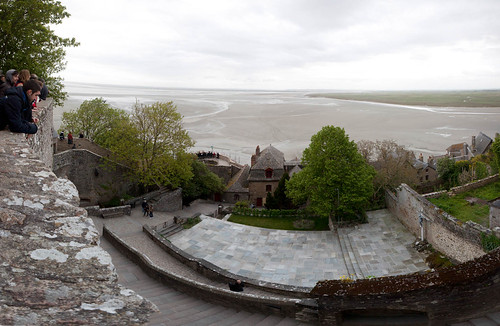
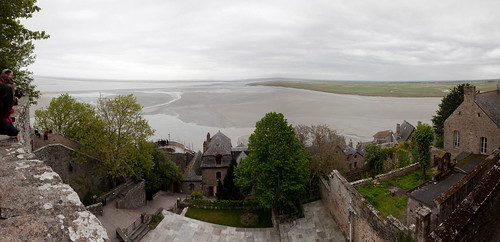
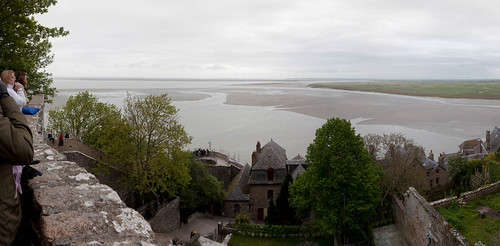
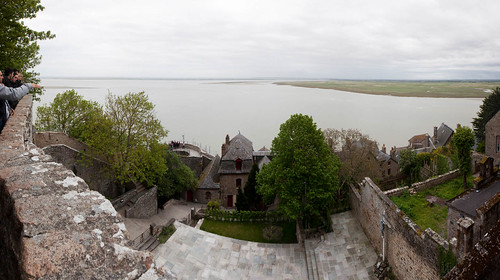
Perhaps the most unique aspect of Le Mont is the tidal flow.  I'm not aware of any other landmark in the world that is sometimes part of the mainland and sometimes an island.  It just takes about 60 minutes for high tide to cause the town to be completely surrounded by water.  We climbed the steps to the abbey and watched the tidal phenomenon happen.


#1: 7:22pm
#2: 7:46pm

#3: 7:58pm
#4: 8:14pm


Related Links:

Friday, May 24, 2013

France 2013: Trip Overview


Bonjour, messieurs et madames!  I just got back from a très magnifique, two-week trip to France.  Unlike my typical trips with friends, this one was a family vacation.  My parents just had their 40th anniversary, and I wanted to take them on a trek in Europe while their health was still in good shape. 
Our trip was spent entirely in northwestern France.  It was the second time in France for all of us. Aside from Paris, all the places we visited were new to us.

Trip itinerary & blog article index:


1) Flew in to Paris (A). With a long layover in Berlin
2) Normandy coast (B): The historic sites of the WWII D-Day invasion
3) Le Mont. St. Michel (C): The medieval city built on an island mountain (photo at top of this article)
4) Loire Valley (D): Region filled with beautiful chateaux (castles/mansions) built by French royalty
5) Chartres (E): Home of the beautiful gothic Cathédrale de Chartres.
6) Paris (F): 4+ days wandering the most beautiful city on the planet

As I write more, I will link to blog articles on the above locations. 

Here are maps of our trip.  The one on the left is a macro view, showing where we were in relation to France overall.  The one on the right shows more detail on the specific locations.


Getting Around

We rented a car to travel to all these locations. It was a great experience. The Normandy coast has a lot of small sites that you can visit, so having our own car allowed us to visit them at our own pace. The car was great for the Loire Valley too, since there are 10-20 chateaux you could visit. We planned around the big chateaux(Chambord, Chenonceau, Villandry); for the rest, we played it by ear. The French countryside was beautiful too. We really enjoyed driving through all the small towns and peaceful country roads.

When you rent a car in Europe, most cars you get are manual transmission. I was the sole driver, and I can only drive an automatic. So I reserved an automatic for a lot more money... but hey, it was a "premium class" rental - so they gave us a BMW 5 Series! What an awesome car for a road trip! The photo above is me with the BMW, in front of Chambord, the most grand of the chateaux in the Loire Valley. It also came with an excellent built-in GPS system, which saved us from getting lost many times.


Driving in Europe has its good points and its bad points. On the bright side, highway driving is great. Everyone is taught to drive very well, it seems. You rarely see slow drivers in the passing lane. People move aside to let faster drivers pass. And you don't see clueless cell-phone users cluttering up the roads. On the other hand, driving in cities and towns can be a pain! The streets are very small and crowded, and directions aren't marked clearly. Parking spots are tiny too. Most cars are very small compact and sub-compact cars; our BMW was quite a behemoth on the roads! Luckily, I managed not to hit anyone or anything...


The one place I did not drive in was Paris. Driving in Paris, just like any of the world's largest cities, is a complete mess! No way! We took public transporation instead. The metro and bus systems in Paris were excellent. Trains ran very frequently and were comfortable (and not smelly and rickety like Chicago's El hehe). The bus system was great too. Although the buses ran less frequently than the trains, there were more buses, and they covered lots of ground. It was nice to gaze out the window and admire the beauty of Paris during the bus rides. Tip to travelers: you can buy a "Mobilis" ticket that gives you unlimited train & bus rides in central paris for the great price of 6,60 EUR. Or a 5-day "Paris visite" card.

The French

Everyone seems to be curious how the experience was when dealing with the French.  I guess they get a bad rep in the States hehe.  Actually, just like my previous time in France, the French were great.  The French, on the whole, have a great sense of taste - whether it's in architecture, food, or fashion.  They are well-read, cultured, and have a good sense of what's going on in the rest of the world.  I think where Americans sometimes rub the French the wrong way is either from being ignorant ("I'm American, I don't care who you are") or not showing interest ("I don't want to try your food, where's the McDonald's?").  If you're gonna visit their country, you just need to be open to their ways.  The French are very proud of their culture and seem to want to share its greatness with you.  We had a great time talking to the locals.  All three of us can read and speak French too, so it made things much easier.  Many were impressed that these strange looking Asian visitors could speak their language.  But even if your French is poor, you get a lot of points by simply trying to speak their language.

Conclusion

It was a great trip!  Hmm, I think every trip is a great trip :)  We saw a lot, experienced a lot, and had spent some good family time together as well.  More blog articles and photos to come!


Monday, September 19, 2011

Florence, Italy


Wow, summer breezed by really fast!  I've been traveling and shooting photos, but I haven't been keeping up with the travel blog.  Now that it's cold and rainy, it's time to go back to the blog.  Let me bring us back to Italy and recount our experience in Florence.

Florence (Firenze) is the capital city of the Tuscany (Toscana) region of Italy.  Florence is probably among Italy's three most visited cities (along with Rome and Venice).  It is an old city - dating back to Roman times, and full of Medieval and Renaissance-era buildings.  Central Florence is full of tourists, yet it feels cozy, vibrant, and charming.


Travel & Accommodations

We rented this beautiful loft apartment in central Florence for four nights.  The price and location were perfect.  We were just blocks from the river, the food, and the major tourist attractions.


Florence is a great city, well worth the visit by itself.  But if you have the time, you must also check out the other towns in Tuscany.  The countryside is beautiful, and the towns are interesting and unique.  Tuscany is also home of Italy's wine country - so you definitely need to sit down and enjoy food and wine.  We ended up dividing our four days: 1-2 days (part of the group split up) in Florence, and the remaining days visiting other towns. In this article, I'll only write about Florence.  The next article will feature the other towns we visited.


Il Duomo


Towering above Florence, the cathedral Santa Maria del Fiore - aka Il Duomo - is perhaps Florence's most well-known building.  It's the fourth-largest church in Europe.  Like most major cathedrals in Italy, it comes in three parts: a cathedral, a campanile (clock tower), and a baptistry.

I didn't have time to go inside the cathedral.  You have to pay an admission fee, plus you have to climb a whole bunch of steps to get to the top of the dome.  Luckily some of my friends did spend the time to visit.  The photos to the right and below were taken by Lily.  The view of Florence from the top of the dome is amazing!


Uffizi Gallery

Florence is perhaps most well-known for its Renaissance art and architecture.  In fact, Florence is regarded as the home of the Renaissance.  The Uffizi Gallery is one of the most famous and significant art museums in the world. 


Getting tickets for the gallery was a bit interesting.  By now, we had learned that Italy isn't very good at communicating instructions clearly.   When we arrived, we saw a very long line for tickets - probably over an hour wait.  I noticed this the last time I was in Florence too.  But we also noticed another door for tickets, so we walked in.  We found that for just another 5 Euro or so, you could buy tickets for later in the day (1pm, 2pm, etc.) - and you didn't have to wait in line!!  Thanks for telling us, Italy....

Unfortunately, you aren't allowed to take photos of the art, so you'll just have to visit it yourself.  Another major museum in Florence is the Galleria dell'Accademia, which houses the famous sculpture David.  I didn't have time to stop in.

Il Palazzo

It seems that every city in Italy needs a Palazzo, and Florence's Palazzo Vecchio ("old palace") does not disappoint.  It's located in the heart of Florence, at the Piazza della Signoria.   The Palazzo is a cool-looking brick building of Romanesque architecture.  It has a replica of the statue David at its entrance (which was enough for me - didn't need to see the real one haha). 


The Piazza della Signoria seems to be where all the action is in Florence.  Not to mention, it's where all the tourists congregate as well.  It makes sense though - the Uffizi Gallery is next door, and the Ponte Vecchio is just two blocks away.  Oh yeah, the Uffizi Gallery has a cool cafeteria that gives you a great view of the Palazzo (no, Kristine doesn't come with the view):


Basilica di Santa Croce


Italy has no shortage of churches!  The Basilica di Santa Croce doesn't look that fancy from the outside, but there's neat stuff within.  First of all, it's actually the world's largest Franciscan church.  But its claim to fame is that it is the burial site of some of the most famous Italians in history: Michelangelo, Galileo, Machiavelli, Dante, and Rossini.

If you aren't into admiring dead dudes, you can enjoy another great feature: the beautiful frescoes on its walls:


Ponte Vecchio


My favorite attraction in Florence is the Ponte Vecchio ("old bridge").  Florence is situated on the Arno River.  The heart of the city sits on one bank, and life spreads across to the other bank. The Arno brings peace and charm to Florence.  There are a number of bridges that span the Arno, but the Ponte Vecchio stands apart, probably due to all the shops that were built on top of it.


The Ponte Vecchio is located right next to the Uffizi Gallery and Il Palazzo, which means that you can find hordes of tourists on the bridge during the day.  It was nice to check it out and see the shops, but I actually didn't enjoy walking on the bridge that much.  It was way too crowded and way too touristy.


If you walk a little further down the banks of the Arno, however, the tourists disappear very quickly.  Now you just hear the flow of the river and feel the warmth of the Tuscan Sun.  I could see myself walking along the banks of the river and gazing at the bridge every morning and every evening.  Maybe I'm just a sucker for rivers and bridges??


A Sunset in Florence


After walking around and breathing art, architecture, and history, you should definitely top if off with viewing a romantic sunset.  There's a great spot for it, at the Piazzale Michelangelo.  The piazzale is just a large parking lot near a church, but every evening, you'll see tourists flocking to it.  It's about a 20 minute walk from the Ponte Vecchio (on the "other" side of the river), with includes going up a hill.  From this perch, you can see the bridges, the Palazzo, the Duomo, and of course, the sunset.  It is breathtaking.


Related articles:

Saturday, June 25, 2011

Rome, Part Due


Let's go back to Rome.  There's so much to see and do in Rome, and you can't easily cover it all in a single article.  In my previous Rome article, I covered the major landmarks in central Rome, located on the east bank of the Tiber River.  Now we'll talk about the west bank.  The Vatican is located here.


Tiber River & Castel Sant'Angelo

From our apartment near the Piazza Navona, it was an easy 10-minute walk west to the Tiber River.  Legend has it that Rome was founded on the banks of this river.  Walking along the tree-lined riverfront is very pleasant.  It provides a peaceful respite from all the tourist-filled landmarks and piazzas.  Rome has built some beautiful bridges than span the Tiber.  The one pictured below (as well as in the photo at the top of this article) is the Ponte Sant'Angelo. 


As you cross the Ponte Sant'Angelo, you come to the immense Castel Sant'Angelo.  This castle was actually originally built as the tomb for the Roman Emperor Hadrian and his family.  It was upgraded to a castle in the 14th Century by the Popes.  They even built a tunnel from St. Peter's Basilica to the castle, so people could seek refuge there (kinda like in the book/movie "Angels and Demons" haha). 


The Vatican

The Vatican is the main attraction on the west bank of the Tiber.  Vatican City is a city-state - a sovereign nation independent of Italy.  It's a tiny country.  Its lands are fully contained within the city walls, and under 1000 people officially live there.  The Holy See, the "government" of the Roman Catholic Church, operates from the Vatican (but it is technically independent from the Vatican City state).  The Vatican is a theocracy.  The Pope is its monarch, a head-of-state just like the American President or the British Prime Minister.  The only other people in the world who also have this dual role of religious leader and head of state are the leaders of Islamic states such as Iran, Saudi Arabia, or Pakistan; as well as the Dalai Lama of Tibet.


Although the Vatican is the seat of a 2000 year old religion and is filled with a wealth of relics and history, Vatican City is ironically a young nation.  It was founded only in 1929.  48 of the U.S. States (except Alaska and Hawaii) are older than Vatican City.  For many centuries, the Papal States was a much larger nation, occupying much of central Italy, from which the Holy See ruled.  Since the fall of the Roman Empire, the Italian peninsula was divided into several nations, including the Papal States (and this division was in flux all the time).  In the 1800's, Italy went through a reunification phase.  I don't know much about this history, but here's what I have read.  The various nations of the Italian peninsula (Venice, Piedmont, Lombardy, Sicily, Naples, etc.) fought outside conquerors (like the Spanish and the Austrians), as well as each other.  After a few wars, the emerging consolidated Kingdom of Italy (led by the Piedmonts) eventually declared war on the Papal States, who opposed the unification.  In 1870, the Kingdom of Italy besieged Rome for a bit, then it annexed Rome.  This ended the Papal States' millennium-long era of being a sovereign nation.  In spite of this huge loss, the Pope and his leadership remained defiant and retreated behind the walls of the Vatican.  The Italian government did not want to attack the Vatican itself and did not care to interfere with the operations of the Catholic Church.  This stalemate, known in Italian history as the Roman Question, lasted for almost 60 years.  It finally ended with a compromise in 1929 - the Lateran Treaty.  This treaty established the Vatican City as a sovereign nation for the Popes, and made Roman Catholicism the official religion of Italy.


The focal point of the Vatican is St. Peter's Square.  A large boulevard leads from the Tiber River to this square.  St. Peter's Basilica is located at the top of the square.  The Pope conducts large public masses in the square.

As I had mentioned earlier, we were in Rome on the weekend of Pope John Paul II's Beatification ceremony.  This ceremony marks step 3 of 4 in becoming a Saint of the Catholic Church - a BIG deal.  As a result, hordes of believers (especially from Poland, where that Pope came from) came to the Vatican for the ceremony.  Officials set up large screens, speakers, and crowd control measures everywhere.  We escaped from town on the main day of the ceremony (Saturday).  But even on Sunday, the Vatican was crowded, because they allowed visitors to view the Pope's casket in St. Peter's Basilica.


St. Peter's Basilica is an immense church of Renaissance architecture.  It's probably the largest all churches in the Christian kingdom, and it's one of the holiest.  Aside from being a huge space for performing religious services, St. Peter's is also well-known for its crypt.  Many Popes are buried there.  The crypt's most famous "resident" is St. Peter himself, the apostle of Jesus who became the first Pope.  Unfortunately, there was such a huge line to get in to the basilica, so we did not make it in :(  The photos above were from my previous trip to Italy.

Vatican Museum and Sistine Chapel


The Vatican Museum is a ginormous museum that houses the collection of artwork gathered by the Catholic Church over the millenia.  It is one of Rome's top tourist attractions.  It is so popular that you usually have to wait an hour or two to get in.  I highly recommend buying a tour, which allows you to get in a special tour group entrance.  When we went, however, everyone was going to St. Peter's Square to see the Pope festivities, so there was hardly any line for the museum.


The museum as a great variety of art work.  There's a lot of Roman art, especially sculpture.  There's a lot of Renaissance and Early Modern Italian art - though mostly portraits of stuffy old people or religious scenes.  What is really impressive is all the art painted directly painted on the ceilings and walls.  Since my last trip, they have also added an entire wing of modern art too.  I think we spent 4 or 5 hours at this museum.  You can probably spend even more time there!


Museums are often cool not just for their artwork, but also for their architecture.  My favorite architectural highlight from the Vatican Museum is its spiral staircase entrance.


At the end of the museum, you are led to its masterpiece, the Sistine Chapel.  We've all probably heard of the wonders of this place.  It's ironic though - when you first walk in, you just notice how small and dark it is.  And it's crowded - hundreds of tourists are always stuffed in here.  But when you look up and see every inch of wall covered by Michelangelo's handiwork, wow, it's pretty amazing.  For some silly reason, they don't let you take any pictures in here.  I'm not sure how this photo got here :)


Related links: