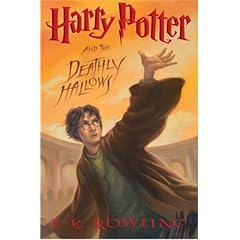
 It's funny. I pre-ordered the book, like many people. Eager anticipation of one of the most highly anticipated books ever! I started reading. Got a couple hundred pages through. And then it sat on the shelf. I'm one of those people with the rare talent of being able to postpone anything. I daresay it is related to procrastination. But it's a step above, since you actually stop in the middle of something enjoyable. It sat for many months, til last week, when I went out of town. I am a much better reader when there are no distractions from home.
Anyways, it was a good book. If you haven't read it and intend to, please go no further. I will have SPOILERS! Well not big ones. But there will be some, oh yes.
Let me start with the bad side. Unlike the Harry Potter fanatics, I actually don't blindly enjoy these books. There were a few things that annoyed me. First of all, it seemed that Rowling invented the last two books to pretty much stand on their own. Yeah, there were some things the led up to them, but the horcrux thing plus the deathly hallows solely came out of the last two books. In the first five books, it seemed as if You-Know-Who was more like that-bad-guy-you-could-never-get-rid-of in cartoons. You know: Wile E. Coyote, Gargamel, Megatron, etc. Then all of the sudden, Harry gets a clue and starts figuring out the bad guy. In Rowling's defense, I guess she needed a way to wrap it all up. Maybe it's because the first couple books were way too simple; she just didn't have much of a story arc to work with.
The other big thing that bugged me about Deathly Hallows was that there was too much explicit explanation. Yes, everyone wants to understand what happened and see all the loose ends get wrapped up. But do you have to make it so obvious? Like the pensieve scene. It just seemed that the plot got so complex that it needed a long-winded, complex resolution as well. Maybe this one time, this story would be better suited as a movie, since you could easily do a dream-sequence-that-reveals-everything.
Now that I've had a chance to whine, let me talk about the good things. It was still quite an enjoyable novel. Rowling did a great job tying all the components of the Harry Potter universe into the last book. It seemed like every good guy and bad guy you met ended up in the book. It incorporated parts of past books, like the Room of Requirement and Dumbledore's Army. The final battle was epic and spectacular. It was a true fight between good and evil, and everyone showed up. Reminded me of the final battle in LoTR. I can't wait to see a movie version of that battle.
Harry did a lot of growing up too. And it was about time. It got a bit annoying seeing him stumble about all the time. He was like a wizardly Inspector Gadget. But in this book (and the previous one), he and his friends actually think strategically. Harry figures out the complex relationships and lore regarding You-Know-Who. And he won over enough people through his actions and his defiance of the bad guys that they would come join him in the final battle.
So, a couple of annoyances aside, Deathly Hallows was a fine ending to a fine series of books. The books are kinda strange as a series - they don't really fit together. The first ones are simple and cater to young children. The last ones are dark and complex, probably way above most 10 year olds' heads. I guess they show a good transition from childhood to adulthood. And thus it ends, with Harry walking away in the sunset. Oh wait - there's an epilogue.... maybe it's not all over... JK Rowling is gonna make more money!!!


