Berlin is Germany's capital and largest city. It's large, it's modern, it's sophisticated, it's multicultural. This was my first visit to Berlin. My impression was that Berlin is Germany's version of London or New York City.

When I think of Berlin, I can't help but think about its role in 20th century history. Most recently, the Berlin Wall came down in 1989, signifying the end of the Cold War between the USSR and the USA. Before that, Berlin was the capital of Germany during World Wars I and II. It was significantly damaged during WWII bombing raids. After all these events, what has Berlin become? I had no idea. Visiting Berlin was a great lesson in history, as well as a refreshing look at how humanity can grow and mend itself after many years of strife.
I grew up during the Cold War. Being born in Vietnam, I witnessed the damage caused by the war between Communism and Capitalism. When my family came to the U.S., we still felt the Cold War - Olympics competitions and boycotts, the space race, the threat of nuclear war, pop culture of the Cold War (remember War Games or Rocky IV?).


I also remember the end of the Cold War - signified by the demolition of the Berlin Wall. Remember Ronny Reagan saying "Mr. Gorbachev, tear down this wall?" Remember that Scorpions song "Winds of Change?" The first time I visited Germany was in 1992, just three years after Wall fell. The people I spoke to (from the West) were a bit upset that their money was being sucked in to rebuild the East. But what happened since? I stopped paying attention. Visiting Berlin allowed me to find out. What you see in the photos above is what's left of the wall: nothing! It has been almost completely razed. In its place are bricks in the ground of a special color.

Although you can't see the wall anymore, you can see some relics of the Cold War. One of the most notable is the Checkpoint Charlie (CPC) memorial. Back in the day, CPC was one of the few places available for passage between East Berlin and West Berlin. It was manned by US and Germany military personnel. The memorial is an outdoor museum that presents various facts and stories related to the Cold War.

During the Cold War, both East and West were desperate to show that their way of life was superior. What happened to Berlin during this time was very interesting (I didn't appreciate it as a child). When Berlin was divided into East and West, Berlin still sat in the middle of Communist East Germany. So West Berlin, which was democratic/capitalistic, was really an island that was not connected by land to West Germany. The Allies ended up spending a lot of money and effort to airlift supplies to West Berlin, just to make it look nice to show off. Their efforts were best seen on the Kurfurstendamm, a beautiful boulevard boasting fancy shops. It's like the Champs-Elysses or Fifth Avenue (NYC) of West Berlin. Our hotel was nearby. Below is a photo of the Breitscheidplatz, the central plaza next to the Kurfurstendamm.

During WWII, the Allies performed many bombing raids on Berlin. As a result, much of the city was destroyed. The Kaiser Wilhelm Gedächtniskirche (Memorial Church), located at the center of the Breitscheidplatz, was destroyed as well. Today it has been rebuilt, and it serves as a memorial to the bombings.

The Reichstag is the name for Germany's parliament. In the late 1800's, this beautiful building shown below was built for the Reichstag. In the 1900's, however, a fire badly damaged the building. It was left unused for decades. German Reunification prompted the restoration of this building. Isn't it grand?


You have to wait in a long line to take the tour of the Reichstag Building. We waited 1.5 hours (which was a relatively short wait). Once inside and through some very tight security, you briefly pass through the interior in which the parliament meets. Almost all your time is spent in a modern dome structure that is situated above the parliament. The dome has a neat spiral path that allows you to walk up to the top. They give you an audio tour as you look at the 360 degree view of Berlin.


The Brandenburg Gate is Berlin's most well-known landmark (see photo below and also the first photo in this article). It is a beautiful classical structure, located just a few blocks from the Reichstag building. The Brandenburg Gate was one of the few landmarks that was not bombed in WWII. During the Cold War, the Berlin Wall stood right in front of the gate. A bunch of ugly Soviet-style buildings were built next to the gate. After Reunification, Germany demolished the ugly buildings and created an open plaza here.
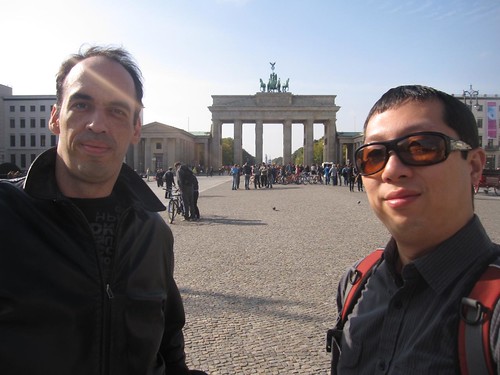
The plaza features a strange assortment of buildings. The US Embassy is located here, for one. Also, there's a building featuring an interior modern art/architecture thingy by Frank Gehry (below). It was our second sighting of Frank Gehry work on this trip (the other was the Dancing House in Prague). Finally, you can find the infamous hotel (below below) in which Michael Jackson held his baby out the window for the world to see and cringe at.


This modern structure below is the Holocaust Memorial. It is also located next to the Brandenburg Gate. There are no stories or photos talking about the Holocaust at this memorial. You just walk through the rows of monoliths and contemplate.

During the Cold War, all the good stuff in Berlin was in the western side of the city. After reunification, the "center" of the city moved east. Reconstruction opened up lots of museums, landmarks, and shopping in the former East Berlin.

One such area is Museum Island. The Spree river runs through the east side of the city. Museum Island can be found along the river. There are five excellent museums on the island, plus the super nice looking Berliner Dom, a Protestant cathedral. Museum Island is a UNESCO World Heritage site.

The most well-known of the museums is the Pergammon Museum. It contains reconstructed ruins of ancient structures such as the Pergammon Altar and Babylon's Ishtar Gate. It was really neat to see how grand these cities were. I didn't even know that anything from Babylon survived at all.


The Neues Museum was destroyed in WWII. It was rebuilt and re-opened in 2009. There is an Egyptian sculpture inside, with the famous head bust of Nefertiti (which they would not let us photograph, argh). The museum also has a Greek (or was it Roman) exhibit as well. The coolest thing about the museum to me, however, was the building itself. The architect used the original 19th century materials, but not the original design. It was cool to see brick, stone, and marble used in strange places, even next to each other.


Potsdamer Platz was once an important city square in Berlin. WWII completely destroyed this area, however. It was left in ruin during the Cold War years. Since Reunification, Potsdamer Platz has been completely rebuilt. It is now filled with modern skyscrapers. One of the neat buildings in the platz is the Sony Center, with a tent-like roof and dining/entertainment activities.


Berlin is a cosmopolitan city. You can find food from all sorts of countries. But if you want to eat something authentic to Berlin, try some currywurst. Like many German foods, it is a sausage. The "curry sauce" is really a mix of curry and ketchup. Talk about fusion! Currywurst is not fine dining; it's fast food. You can get it from street stalls, or you can go to one of these currywurst chains, which are supposed to be the best.

Another authentic German experience was drinking some Kolsch beer. Although Kolsch came from Cologne, not Berlin, we were able to get some good stuff anyways. Unlike may German beers, which are served at room temperature, Kolsch is supposed to be served cold. It's served in long but thin 0.2L glasses (rather than 0.5L or pint-sized glasses or the large 1L mas steins).


Mo's brother and his family live in Berlin. They had us over for dinner one evening. Here's a photo of "Tio Mo" and his very cute niece.

You can find all kinds of entertainment and nightlife in Berlin. We didn't have enough time to experience much of it, but it seemed pretty cool. In particular, there were some nice streets lined with restaurants and outdoor seating. More unique were the venues found in alleys and abandoned buildings.

To wrap it up, Berlin is a very modern, very metropolitan city. It has grown, however, in the shadow of its recent history - WWII and the Cold War. German Reunification has brought forth a renaissance of redevelopment and growth. I look forward to seeing Berlin in another few years, to see how much more it has evolved.
Related links: